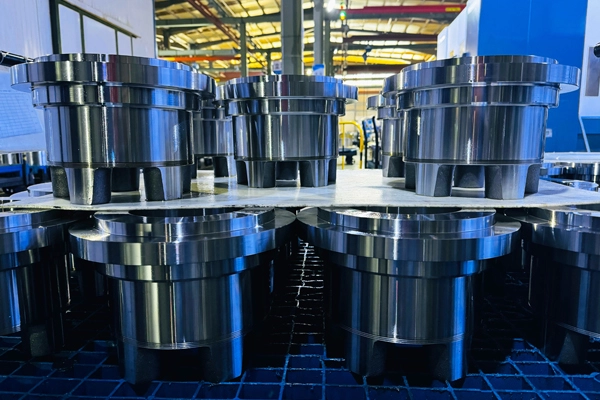
Walkson specialize in providing high-quality forging solutions tailored to meet the demands of heavy industrial applications. With advanced forging techniques and a focus on precision, our services ensure durable and reliable components designed to perform under the most challenging conditions.
Our forging china capabilities include open die forging, closed die forging, and seamless rolled ring forging, utilizing materials such as alloy steel, carbon steel, stainless steel, and non-ferrous metals. We manufacture critical components such as shafts, flanges, gears, rings, and other parts for industries like power generation, oil and gas, mining, and construction.
With state-of-the-art facilities and strict quality control processes, we guarantee products that meet international standards, including ISO and ASTM. Whether it’s custom designs or high-volume production, we deliver cost-effective solutions with timely delivery, making us a trusted partner for industries worldwide.
Forging vs. Casting vs. Machining: Making the Optimal Choice
Selecting the right manufacturing process is critical for part performance, cost, and lead time. Here's a quick comparison:
Expert Insight: For critical, load-bearing parts in demanding industries like energy and heavy machinery, forging is often the optimal choice due to its unmatched mechanical properties and reliability.
High-Performance Forging Applications Across Key Industries
Manufacturing Consultation: Our engineers ensure full compliance with international standards for your custom projects.
Understanding Different Types of Forging Operations
Closed-die Forging (Impression-die)
Closed-die forging is a kind of forging method which drives a plurality of punches or die cavities, makes the material mainly carry out lateral extrusion deformation flow, enters the die space set on the side, and produces the forging with radial protrusion.
Open-die Forging
Open die forging is a kind of forging method which makes the metal deform freely in all directions between the upper anvil and the lower anvil by using the impact force or pressure, and obtains the required shape, size and certain mechanical properties without any restriction. Utilizing advanced hydraulic press technology and computer-controlled heating furnaces to ensure precise Recrystallization Temperature management during the Deformation process.
Alloy Steel Forging
Alloy steel Forging widely used in the industry, include forging shaft, forging rings and so on with many advantages.
Stainless Steel Forging
Stainless steel Forging widely used in the industry, include forging shaft, forging rings, etc.., The main advantage of stainless steel is corrosion resistance or high-temperature resistance
Carbon Steel Forging
Carbon steel forging with super toughness and bending strength. The hook is made of super high carbon steel with super toughness and bending strength. The hook has been forged, the hook point is sharp and not easy to break, and the penetrating force is strong. The surface is treated by special oxidation and electroplating, with super high wear resistance and excellent corrosion resistance.
Roll Forging
Roll forging is a kind of rotary forging. In recent decades, longitudinal rolling has been introduced into the forging industry, and a new forging process has been formed through continuous development. Roll forging is a plastic forming process in which materials produce plastic deformation under the action of a pair of reverse rotating dies to obtain the required forgings or forging billets.
Hot Forging
Hot forging is also called hot die forging. During the hot forging process, the deformed metal flows violently and the forging contacts with the die for a long time. Therefore, the mold materials should have high thermal stability, high temperature strength and hardness, impact toughness, heat fatigue resistance and wear resistance, and be easy to process.
Aluminum Forging
Aluminum Forging Aluminum alloy has low density, but high strength, close to or better than high-quality steel, good plasticity, can be processed into a variety of profiles, with excellent conductivity, thermal conductivity and corrosion resistance. It is widely used in industry, and its usage is only second to that of steel.
Cold Forging
Cold forging is a kind of forming processing for materials below recrystallization temperature,it is forged below recovery temperature, forging without heating blank is called cold forging.
Press Forging
Press forging is a widely used process for shaping metals by applying a gradual, controlled force to deform the material into the desired shape. Its applications span various industries due to its precision and ability to create strong, durable components.
Titanium Alloy Forging
Titanium alloy forging involves shaping titanium or its alloys using compressive forces applied through forging processes such as open-die, closed-die, or press forging. Titanium alloys are highly valued for their exceptional strength-to-weight ratio, corrosion resistance, and ability to withstand extreme temperatures, making them ideal for demanding applications across various industries.
Nickel Based Alloys Forging
Nickel-base alloy forging involves shaping alloys with a high percentage of nickel (e.g., Inconel, Hastelloy, Monel) into desired forms using compressive forces. These alloys are renowned for their exceptional resistance to heat, corrosion, and oxidation, making them ideal for high-performance and extreme-environment applications. Forging enhances the material’s mechanical properties by refining its grain structure and eliminating defects.
FAQ: Professional Guide to Forging Processes & Operations
What are the 3 main types of forging processes?
The three primary types are Open-die forging, Closed-die forging (also known as impression-die), and Seamless rolled ring forging. While open-die forging is ideal for large, simple shapes like shafts and bars, closed-die forging is preferred for complex, high-precision components, and rolled ring forging is specialized for creating durable circular parts.
Which forging operation is best for different types of materials?
The choice of forging operation depends on the material's properties. For example, alloy steel and carbon steel are versatile for most processes, while titanium and nickel-based alloys often require precise temperature-controlled hot forging or press forging due to their high strength and heat resistance. Aluminum forging is typically chosen for lightweight yet high-strength industrial applications.
Forging vs. Casting: Why choose forging for heavy industrial parts?
Forging is often the optimal choice for critical, load-bearing parts because it provides superior strength, fatigue resistance, and microstructural integrity compared to casting. By aligning the metal's grain structure, forging ensures that components like gears and shafts can perform reliably under high-stress and challenging conditions where cast parts might fail.
Do you provide engineering consultation for custom forging designs?
Yes. We specialize in providing high-quality, tailored forging solutions to meet specific industrial demands. Our expert team offers engineering consultation (replacing traditional technical support) to help you select the optimal manufacturing process, material, and design for custom high-volume production or low-volume specialty orders.
We can also provide kinds of undercarriage components for sale, if you are interested, please contact us.